
It's Just Like This
A Meditation on the Incarnation - Advent Week 2
AUDIO VERSION
I. To Save a Little Wren
This summer a house wren made a nest in a potted plant on our deck, right outside our sliding glass door. Wrens love to build nests in the corners of human things. Garages, door frames, windowsills, sheds. Allison had put this little plant outside on the metal cart I use for our pizza oven, to give it a little sun. A few days later, a pair of wrens had constructed a little cave of grass and moss and string in the pot. They settled in and laid their eggs and waited.
And so did we. Each day we would peak at them through the window, and sneak pictures of the eggs when the parents were out hunting for insects. There were four eggs - lovely, tiny cream-colored things, speckled reddish brown. When they hatched, we watched as the parents busied themselves all day bringing caterpillars, moths, and spiders to the chicks.


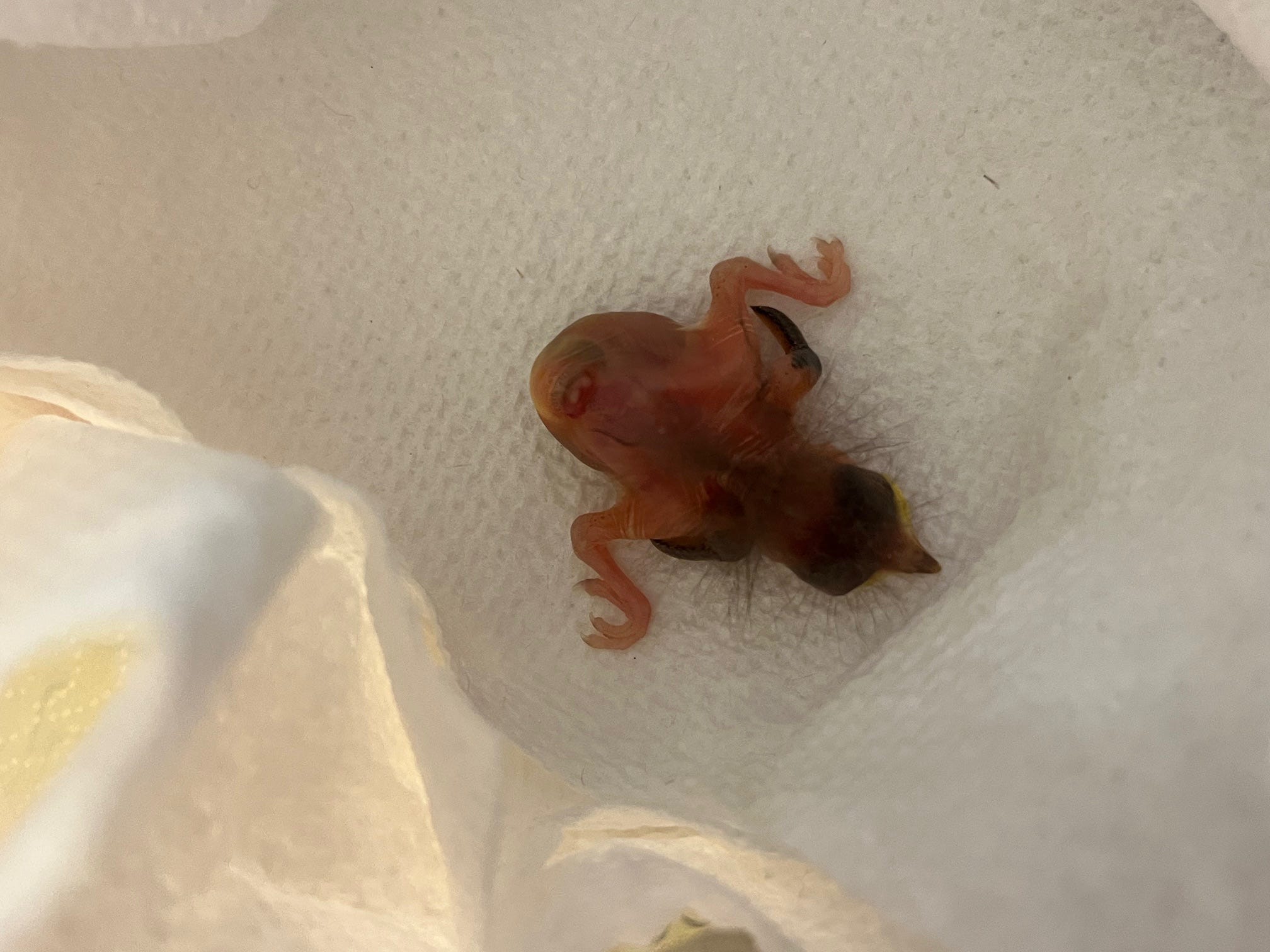
And then one day I came home to find one of the chicks on the deck. It took me a moment to understand what it was – this tiny, naked red body, smaller than a mouse. I could not imagine how it had fallen out of its nest. It could barely move. I knelt down and looked at it, and it was breathing, so I scooped it up onto a paper towel and took it in and put it on the kitchen table. What should I do? A little research online led me to the sad fact that sometimes wrens will throw a baby out of the nest if they are not able to feed them. They will often choose the smallest one, to give the healthier siblings a better change of survival.
I looked at the little bird. I could almost see its heart beating through its translucent pink skin. I had no idea how to take care of such a vulnerable, wild thing. So back to the internet, to see if there was someone who took in little lost birds. And there was!
The Virginia Department of Wildlife Resources keeps a list of wildlife rehabilitators who will take in injured animals. I found one near my home and gave her a call. A woman answered the phone. Her voice sounded tired and brusque and business like. “What kind of animal are you calling about?” she asked.
“Uh…I have this little wren who fell out of the nest.”
“Ok – keep it warm. When can you get over here?”
“Well, I only live a few minutes away.”
“Ok. Come on. Someone will answer the door.” And she hung up.
I held the bird in a shoebox while my son, Joseph, drove us over to the rehabilitator’s house. It was in a neighborhood where I had never been, and we were counting the mailbox numbers as we drove down the street so we would not miss the house. Then Joseph said, “It has to be that one.”
We pulled over in front of a home whose yard looked like a zoo. Everywhere there were bird houses, cages, pens, feeders, and little houses for animals. It was like stepping into a children’s book about lost animals, or some bizarre Noah’s ark. We took our little baby wren in the shoebox, walked up to the door and rang the bell. A young woman answered and cheerfully greeted us. “Do you have the little wren?” she asked. I handed her the box. “Oh, hello little baby,” she said. She handed the box to an older woman who smiled and took the bird into the house.
I peered in to the entrance of the home. It was also filled with birds and other animals. A big turtle in a crate. A goose. A little pig. The house reeked of animals – feathers and fur and feed and piss and wood chips. Every space possible in this house was a home for some lost creature – baby birds, turtles, squirrels. Creatures that had lost an eye, or a wing, or a leg, or just lost their way.
“Will it be OK?” I asked.
“Oh sure,” said the young woman. “We get them all the time. The first couple of weeks are tough, but if they make it through that they will be OK.”
“Do you feed them?”
She smiled. “Yup – about every hour, and all through the night. But there are a bunch of us who help.”
We thanked her and stepped outside. I looked again at all of these creatures, the chaos of caring for lost and broken things. How this woman had taken her house, and made every inch of it into a home.
II. Nothing Greater Than That
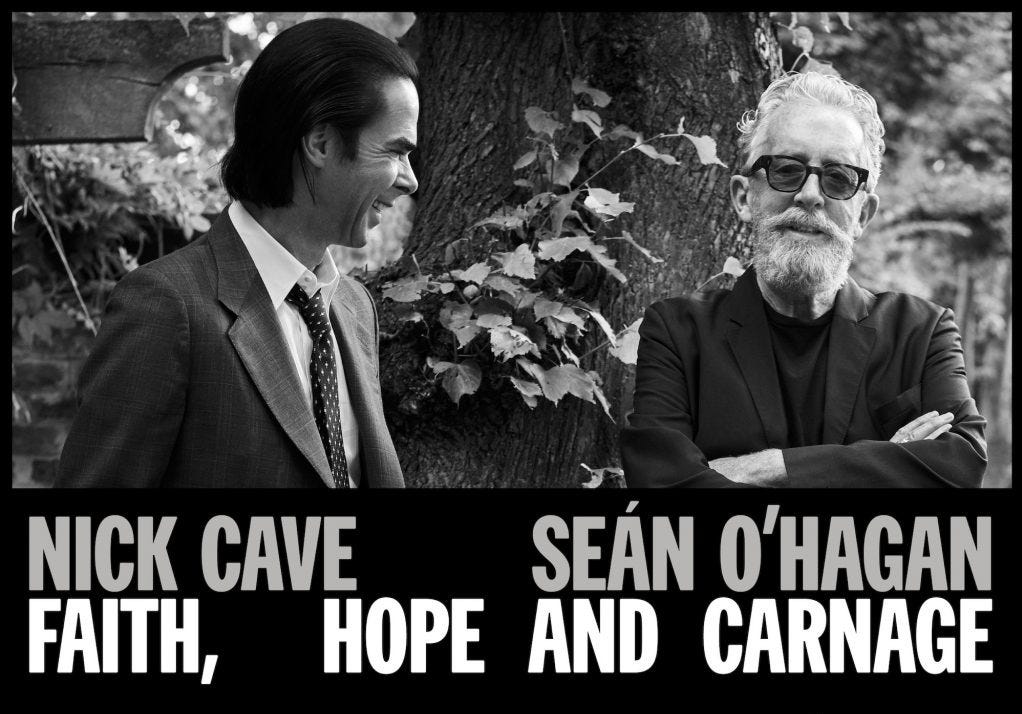
I have been reading a very good book recently - Faith, Hope and Carnage by Nick Cave and Seán O’Hagan. Nick Cave is a well known musician, the founder of Nick Cave and the Bad Seeds. His music is tough to categorize – he came up just past the punk scene, and writes powerful, haunting, deeply religious songs. A sort of musical Flannery O’Connor – his music explores the raw edges of faith and experience. The books is a series of interviews between Cave and a friend, the music writer Seán O’Hagan. They talk about music, God, and very powerfully, about Cave’s experience of the loss of his son, Arthur, who died in a tragic accident at age 15. It is a beautiful and moving book.
In one of the chapters, Cave and O’Hagan talk about Anita Lane, a musician and poet who had recently died. She was a mutual friend of theirs and was very close to Nick Cave when they were young. Her career had never had the success that Cave considered that it should have. In her early forties, she had moved with her children back to Australia, and had simply lived there in a house and raised them.
Her death causes Cave to reflect on what he thought of Anita’s life, and how he might have been too dismissive. He shares with O’Hagan an experience of Anita. At her home in Australia, she hosted a party for her son with all of these wild kids, a real blowout. And in the midst of it, surrounded by kids who are drinking and playing music and smoking and dancing – she is able to bring them all to a hush. She calls them all together and gives a moving speech about her son, and how much she loves him. Here is this middle-aged lady with all these kids, and there is total silence. In the midst of that chaos, her tender love for her child becomes the center of the whole place.
In retelling this story, Cave reflects on art and love in a moving way:
You know, we often talk about the importance of art, that art is the most significant or consequential of gestures, our greatest achievement, the very best we can offer the world, all that. And sometimes I used to get angry at Anita that she sort of wasted her staggering talent, because she wouldn’t apply herself and had no discipline. But, these days, I don’t know. I really wonder about that. I regret it, you know, I really do. I think of Anita in that moment at the party, articulating her love for her boy to all those feral kids, who listened to her words because… God, I don’t know what the lives of those kids were like, but you have to think there is nothing greater than that, nothing at all, that powerful, radical, caring instinct. There was a profound goodness in Anita, that’s what I’m trying to say - just an astonishingly valuable human being. I’m so sorry that she’s gone. (pp. 204 – 205)
There is nothing greater than that, nothing at all – that powerful, radical, caring instinct.
III. The Incarnation is just like this
One of the temptations of the spiritual life, as poet David Whyte warns, is to wait until conditions are perfect to be present to what we really love. In Christian terms – we find it difficult to believe that it is within our regular, domestic, busy lives that God is present to us. I am aware that I often want religious experience as an escape from my life – into a life where I am thinner, wealthier, healthier, and exempt from the difficulties of living. As if there is some future perfection that I can reach where God will finally arrive. And while that is attractive, and certainly there is nothing wrong with wanting those things – it is absolutely the opposite of what the mystery of the incarnation seems to invite us into.
There is a lovely episode from the old sitcom “Mad About You” with Helen Hunt and Paul Riser. It is a funny and sweet show follows the lives of a Paul and Jamie, a newly married couple, as they negotiate marriage and work and raising a child. There is this little moment I have always remembered – Paul and Jamie are arguing in the kitchen, and Jamie is just done.
Jamie: I just don’t know why this is so hard.
Paul: What?
Jamie: This. Everything. Marriage. It is supposed to be different than this.
Paul: Says who?
Jamie: Everyone!
Paul: Well, they’re wrong. Its just like this! It’s exactly, exactly like this.
Bonnie Thurston, a wise writer about the spiritual life, observes:
“The thrust is that our spiritual lives are in the details: how we dust the house, respond to our co-workers, or treat the checkout person at the grocery store. Quite a lot of life, and thus spiritual life, is taken up with routine and repetitive tasks like doing the laundry and cleaning the bathroom. How we do them, with what attitude we approach them, is who we are.
Thomas Merton accurately observed – “If you want to have a spiritual life you must unify your life. A life is either all spiritual or not spiritual at all.”
Bonnie Thurston, Hidden in God: Discovering the Desert Vision of Charles de Foucault, pp. 88-89
In the Gospel of Luke, there are two images in the beginning of the Gospel that give shape to everything that comes. They represent the two competing forces in the story of Jesus. We find them in the first two chapters which tell us about the birth of Jesus, and we see them vividly when the little family of Mary and Joseph arrive in Bethlehem the night of the birth of Christ.
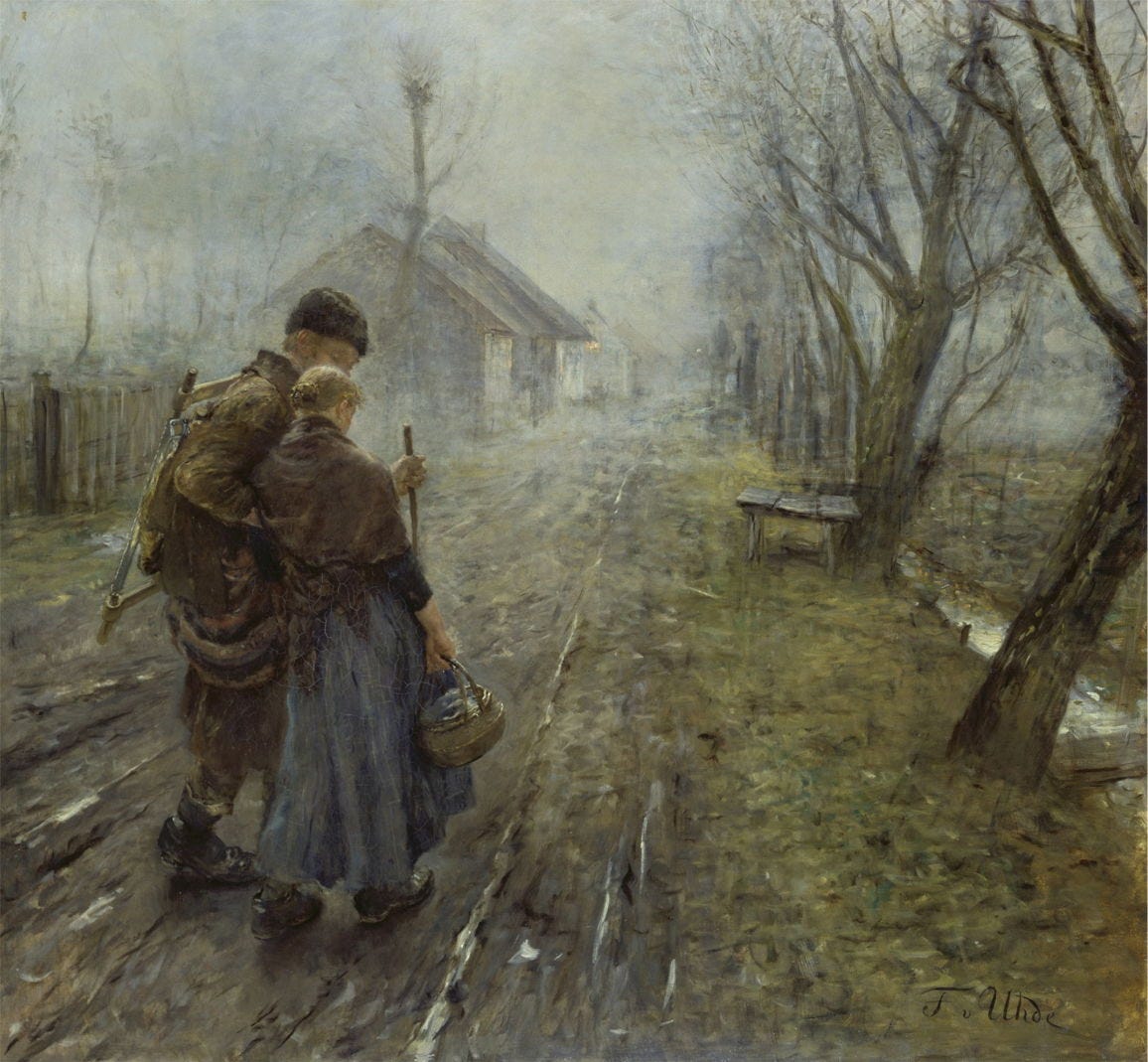
The first image is this young family, on the streets, looking for a place to stay because they have been told they must leave their home and travel to Bethlehem. This image reveals the force of the Roman state, which has ordered that the whole world will be counted in the census. Everyone’s lives will be shaped by the order and power of Caesar Augustus. It does not matter where you live, what you think, who you are. This is the world of power, of pressure, of fear, of ruthlessness. There is no patience for things as they are. There is no time for imperfection, for strangeness, for mess. This is the world where there are no particularities, no human stories. There is no hush when a woman says how she loves her son. There is only power. This is the power that Jesus will face again and again, and that will ultimately take his life. As Thomas Merton wrote of this – it is the “time of no room.” This little family, this tiny community of human hope and desire and love – are forced to leave their home, and they arrive in a place with no room for them.
And then there is this other image – the one the angel reveals to the shepherds as the sign that God has been born. “You will find an infant wrapped in swaddling clothes, and lying in manger.” The infant is swaddled because that is what you do for a newborn baby. You wrap this tiny living thing in clean, warm blankets, wrap it up tight, because then the baby feels safe and warm and unafraid. That is what human love looks like. It is care – practical, present, intimate. It is what parents do for children, what health care workers do for patients, what teachers do for students, what coaches, cops, pastors, gardeners, soldiers, cooks, janitors, bartenders, farmers, bankers, lawyers, and everyone who does the work of caring does. It is what that gruff lady who takes in lost and wounded birds does, how she fills her whole house with wild animals because this is what it means for God to become incarnate in Virginia in her actual life. She is not waiting for a better home, a perfect home, the perfect bird. Because she is open and present in this life, her only and actual life - she has room for everything.

The strange mystery seems to be this: the only way to encounter the eternal is through the limited. The only way to draw close to perfection is to love imperfect things. The only way to know the God of all power is through local, practical, sometimes difficult acts. Diapers. Mops. Meetings. It’s just like this.
The power of Christ comes into the world to resist the power of Caesar. But the power of Christ will be intimate. Caring. Healing. Loving. It will look small and useless and messy. Because that is the only way love can be real. In real lives.
Here is a little bird. She needs to be fed all through the night. You will be tired, you will be bored, you will be impatient. But you care for the little bird.
And this will be the sign for you.
It’s exactly like this.
For Reflection:
I think I am interested lately in how the commitment of people to actual, practical lives and institutions is a force for good. Perhaps because so much of our attention goes to our online world, there is pressure to “appear” a certain way, to participate in the outrage-industrial complex. I find that I am drawn to a Christian teaching and spirituality that encourages and lifts up the local, domestic, and practical.
For this week of Advent, two invitations for reflection:
Who is someone in your life whose care and love for others has had a deep impact on you? Perhaps someone who is overlooked but does the quiet, necessary work of care for others?
And it is always good to ask ourselves difficult questions! So a second point for reflection might be where in your own life are you closing the door to God’s presence? Where are you waiting for things to be perfect in a way that closes you off to what is actually possible in your own life?
Resources:
This is how I came across Nick Cave and Sean O’Hagan’s book. Elizabeth Oldfield hosts a really good podcast called The Sacred. She speaks with all kinds of people, and has a genuine curiosity about faith and how it works in peoples lives.
I love this little poem by James Tate. There is just something beautiful in Jesus’s calm, and love for his donkey that unfolds into his love for everyone.
Goodtime Jesus – James Tate
Jesus got up one day a little later than usual. He had been
dreaming so deep there was nothing left in his head. What was
it? A nightmare, dead bodies walking all around him, eyes rolled
back, skin falling off. But he wasn’t afraid of that. It was
a beautiful day. How ‘bout some coffee? Don’t mind if I do.
Take a little ride on my donkey, I love that donkey. Hell, I love
everybody.
Here is a poem of mine – this is about a day when I was able to be open and present to my whole life. (This does not happen often!)
To do list

Today there is a wide blue sky.
The sun – the shy winter sun –
is generous. The snow softens the streets, the fields and homes,
curls up beneath the trees.

Today I lived as one should –
loving the things of my life without question.
Before dawn I took the dog out
and watched her trot round the dark borders of the yard.
I could see all the stars in this piece of sky.
Every few minutes, an owl called out
from the great oak beyond the fence
keeping the time like a church bell.

I made coffee and sat at my desk stacked with books.
I made a to do list, and wrote a few lines of a poem.
I cleaned the toilet and the sink and the shower.
I changed the sheets on our bed.
Allison cooked eggs and oats and cut a red apple
into white quarters and gave me half of them.

Our sons resurrected from sleep –
Eyes tired, hair wild, young bodies lithe and strong –
seeing them made me feel free.

There was no part of my life that was a burden.
The to-do list fell from my lips
like a psalm.
Perfect timing! Thank you for the reminder that my holiday to-do list is not a separate thing from my spiritual preparations during Advent. By the way, I have kept on my refrigerator the drawing I made in response to a sermon you gave at WUU on a similar theme. "This is exactly how it is supposed to be."